LEARNING TECHNOLOGY / SYSTEMS INTEGRATION / CHANGE ENABLEMENT
Canvas + Jenzabar Integration
Implementation leadership, faculty readiness, and sustained grade integrity
A phased institutional implementation that stabilized enrollment data, connected Canvas grades to Jenzabar J1, prepared faculty for a new grading workflow, and established a sustainable reconciliation process for grade accuracy.
Sustained less than 2% grade discrepancy across three consecutive terms
Project Overview
William M. Drayton III led an approximately 18-month initiative addressing two connected institutional problems: an inherited enrollment integration that was unstable and difficult to maintain, and manually entered SIS grades that could differ from the academic evidence and final grade recorded in Canvas.
Phase 1 stabilized the enrollment feed and established the intended Canvas course environment using Jenzabar J1 data. Phase 2 introduced grade transfer from Canvas back to J1, creating a bidirectional exchange between the learning management system (LMS) and student information system (SIS).
Faculty readiness, registrar controls, training, communication, and reconciliation were part of the implementation, not separate activities.
The Challenge
Systems reliability
The inherited integration could fail and required significant technical intervention to recover. Dependability and maintainability had to be established before expanding the exchange.
Academic data integrity
Manual SIS grade entry created a risk that a student’s official grade could differ from the grade and supporting academic evidence in Canvas.
My Role
William’s direct implementation leadership spanned technology, operations, learning, and measurement. He connected technical requirements with faculty practices, registrar controls, and evidence of grade accuracy.
Integration requirements
Canvas organization and course-structure requirements
Coordination with the internal programmer and Jenzabar consultant
Development feedback on the inherited Boomi/JavaScript integration
Faculty readiness assessment
Training and workshop design
Communications planning
Success metrics
Registrar coordination: grading windows, blackout periods, verification, and post-submission controls
Development of the Python reconciliation script
Phase 1: Establishing a Reliable Enrollment Baseline
The first phase made the Jenzabar-to-Canvas enrollment integration dependable and maintainable. It established the reliable LMS environment needed before grade transfer could be introduced.
Account hierarchy
Defined the account structure needed to organize the Canvas environment.
Course organization
Established understandable, consistent organization for institutional courses.
Courses and sections
Specified the course and section structure supported by the enrollment feed.
Naming conventions
Combined course codes, session codes, and course titles into understandable names.
Phase 2: Connecting Official Grades to LMS Evidence
With a reliable baseline in place, the integration became bidirectional. Faculty retained responsibility for verifying transferred grades and meeting attendance requirements.
Jenzabar J1 → Canvas
Enrollment and course information established the learning environment.
Canvas → Jenzabar J1
Gradebook information connected official grades to LMS evidence.
Operating considerations: Cross-listed courses; Corrections during the grading window; Grade changes after the grading window; Incompletes; Registrar-controlled exceptions.
Faculty Readiness and Change Enablement
William used an EvaluationKIT readiness assessment to identify faculty understanding, confidence gaps, and support needs. Findings informed workshops, training, job aids, communications, and grading guidance.
Faculty needed to understand how assignment configuration and gradebook practices directly affected information transferred to the SIS. Support addressed the practices that shape accurate source data.
Grading schemes
Assignment settings
Assignment weighting
Due dates
Gradebook settings
Ungraded work
Weighted groups
Assignments carried forward from earlier terms
Grade visibility
Support Evolved With the Rollout
The project progressed from initial implementation training to targeted performance support. The emphasis was timely guidance at the point of work, not training volume.
Phased launch training
Faculty Focus sessions
Ten Gradebook Commandments job aid
Midterm communications
Pre-final grading communications
Submission-deadline guidance
Knowledge base resources
Measurement and Sustained Results
William developed a Python reconciliation process comparing Canvas gradebook data with Jenzabar exports while transfers occurred. During implementation, the audit ran daily to identify and investigate discrepancies.
Findings guided developer feedback, faculty follow-up, operational refinement, and guidance updates. A successful script execution was not treated as proof that grades were accurate.
Early reconciliation
Fewer than 8% of courses had accurate data alignment.
Mature state
Less than 2% discrepancy across three consecutive terms.
Reconciliation in Practice
The April 29, 2026 audit classified records for alignment review and follow-up. The original displayed percentages remain preserved in the screenshot; they have not been reinterpreted or recalculated.
2,061
Fully Aligned records
81
Monitoring records
20
Needs Alignment Review records
4
Likely lacking graded work

April 29, 2026. Original audit classifications and displayed percentages.
The Grade Transfer Operating Model
The workflow made responsibilities visible across Canvas, Registration and Records, the integration script, and faculty. It connected grade preparation, transfer, verification, correction, and release.
Faculty prepared and verified grades; registrar controls established grading windows and release conditions; the integration exchanged data; corrections and exceptions followed the operating process.

Grade preparation → transfer → verification → correction → release.
What Made the Process Sustainable
The final solution was not only an integration. It was an operating model connecting technical reliability, accurate source data, human responsibilities, controls, and repeatable verification.
Training and knowledge-base resources continue to support the process as faculty and academic terms change.
Stable enrollment baseline
Grade transfer
Accurate faculty source data
Registrar controls
Faculty guidance
Repeatable reconciliation
Exception handling
Selected Project Evidence
Selected artifacts document the rollout, faculty support, operating process, and reconciliation. The cards below identify evidence categories; individual source materials can be added as they become available.
Rollout and Integration Training
Phased launch, grade transfer, verification, grading schemes, and faculty preparation.
Faculty Retreat Materials
Integration alignment to departmental goals and improvements in missing SIS grades.
Faculty Focus
Follow-up training with learning objectives and targeted gradebook discrepancy topics.
Gradebook Commandments + Communications
Point-of-work guidance supporting faculty actions around grading deadlines.
Process Guide + Workflow
Responsibilities, corrections, cross-listing, incompletes, and escalation.
Audit + Course Risk Views
Reconciliation, exception classification, and course-level follow-up.
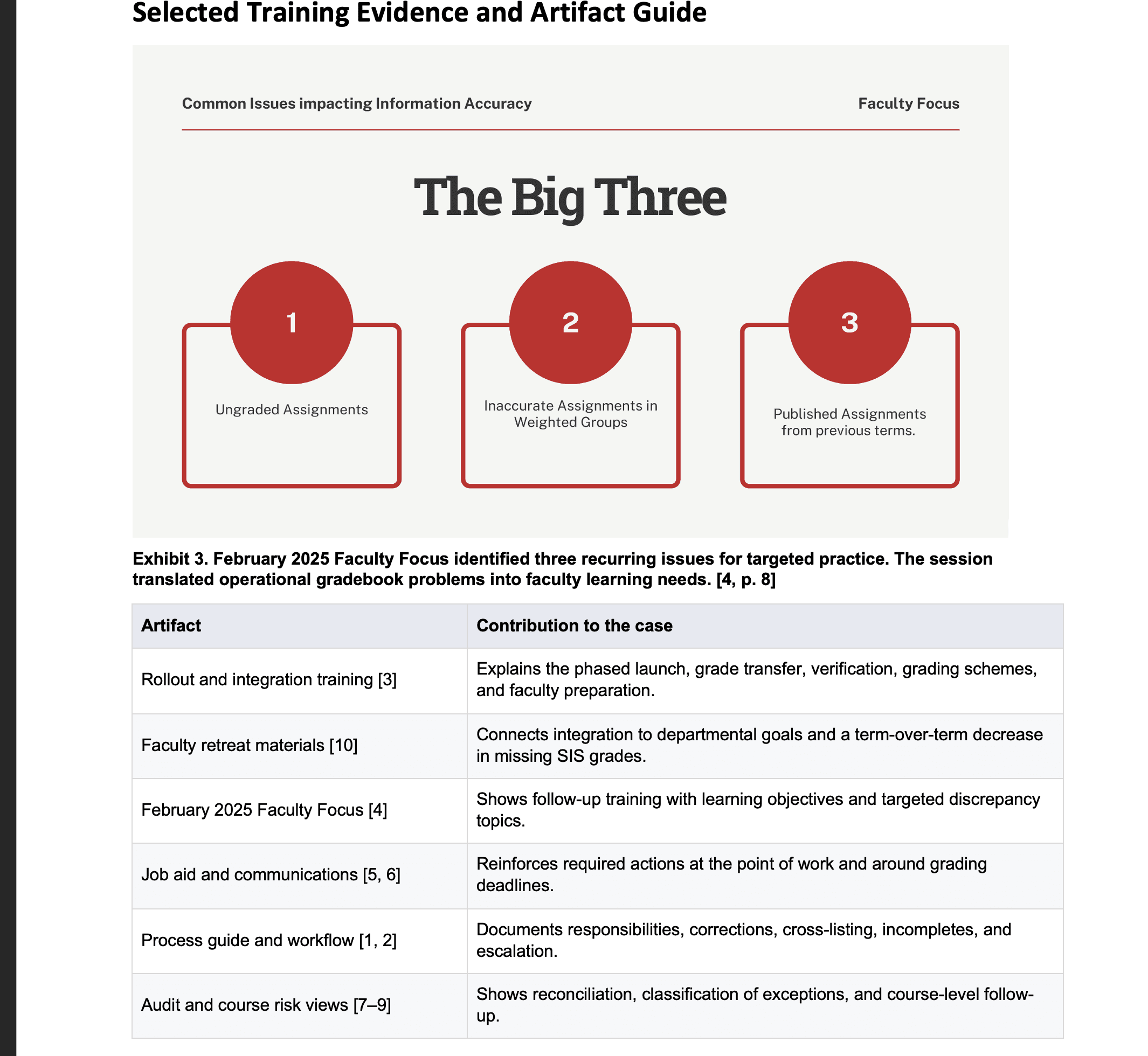
Faculty Focus topics and supporting project artifacts: guidance at the point of work.
Outcome
The project matured from an unstable inherited integration and manual grade-entry risk into a repeatable operating process connecting the LMS, SIS, faculty practices, registrar controls, and ongoing reconciliation.
The strongest measure of maturity was sustained performance across multiple terms, rather than a single successful implementation event.
Less than 2% discrepancy
Sustained across three consecutive terms.
What This Demonstrates
Learning Technology
Systems Integration
Implementation Leadership
Change Enablement
Faculty Development
Process Design
Data Integrity
Python-Based Reconciliation
Cross-Functional Stakeholder Management
Better systems require more than better technology.
Sustainable implementation connects technology, people, process, controls, and measurement.
NOTYARD
© 2026 NOTYARD. Built for what’s next.